Why We Don’t Talk About Sex—And the Founders Who Do


By: Cathy Campo, Co-Editor-in-Chief
I should probably start with a confession: for someone who writes The Kelloggian’s Sex and the Chi-ty column, I don’t actually talk about sex all that much.
In practice, my column is more about dating. It’s easier to dissect texts than to interrogate intimacy. Which is why talking to Ayaka Utashiro 2Y ‘26 felt, in a word, disarming. Ayaka does not shy away. Not when she moved from Tokyo to the U.S. for the first time to attend Kellogg. Not when she pivoted from a career in law to pursue business. Not when she joined GroupWerk and took the stage. And certainly not when she decided to build a company centered on something many of us still struggle to name: sexual connection.
“I found this to be my calling,” she told me over Zoom, matter-of-factly.
Before Kellogg, before NAMI Experiences, before any formal articulation of the “female orgasm gap,” Ayaka found herself trying to solve the problem in the most direct way possible: by writing a 15-page document explaining her own body to a partner. It was detailed, instructional, and born out of a mismatch between expectation and experience—one that, as she would later discover, was far from unique.
That document eventually became something bigger. Earlier this year, Ayaka shared her account publicly in a Hear My Story talk in front of almost 100 Kellogg classmates—an act that, for many, would feel unimaginable. For her, it was necessary.
Her company, NAMI, is—on paper—a couples’ retreat. But in her words, it’s something more intentional: “a couple’s intimacy retreat where masterclass meets vacation.” The framing matters. As Ayaka explained, people resist anything labeled a “workshop,” especially when it comes to sex. But a retreat? That feels like an investment, an experience, even a celebration.

“We’re not fixing a problem,” she said. “We unlock deeper intimacy… We bring couples together and help them get on the same page to address a common gap in couple dynamics.”
That distinction—between fixing and expanding—sits at the core of NAMI. Many programs in this space focus on repair: rekindling passion, addressing dysfunction, and recovering from disconnection. Ayaka’s approach is “preventative.” What if couples didn’t wait until something was broken?
Co-founder / Chief Strategy & Financial Officer, Alan Lan (2Y ‘26), continued: “To me, NAMI is about bringing couples together to start conversations that are often left unspoken. I think about my own experience in my early 20s, trying to figure out what healthy intimacy actually looked like. A lot of what I was absorbing came from porn, and it took time to realize how far that was from reality—how much it distorted my understanding of what intimacy could actually feel like between two people. Unlearning that was its own journey. NAMI exists in that space—helping couples explore intimacy in a way that feels intentional, honest, and truly shared.”
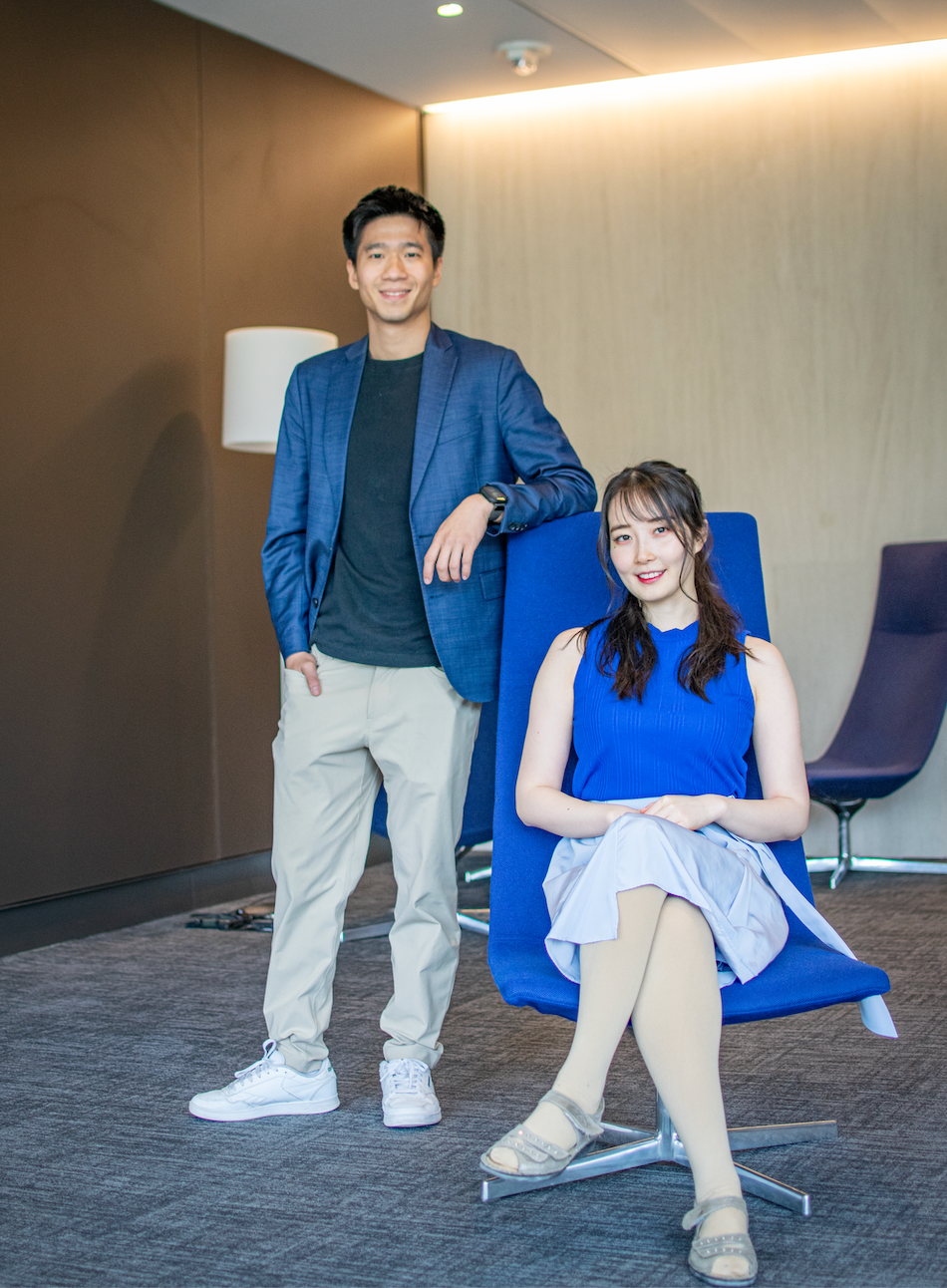
The idea for NAMI didn’t emerge from a grand business plan. In Professor Schonthal’s New Venture Discovery class, Ayaka brought forward a problem rooted in her own experience. What followed was a team of four classmates (the original team has since parted ways, as is often the case with early-stage ventures), over 40 interviews across genders and sexual orientations, and a realization: the issue was far more widespread—and far more silent—than she had imagined.
“There were so many painful stories [of women not enjoying sex]… [and] the statistics understate the real severity,” she said.
One statistic in particular stood out: 90% of men report experiencing an orgasm in their last sexual encounter, compared to just 65% of straight women. It’s a gap that’s been widely discussed, but rarely addressed in ways that feel actionable.
Ayaka’s perspective reframes the conversation entirely. “Sex is, after all, a skill,” she told me. “It’s not just knowledge.” In the same way you wouldn’t learn to work out solely by reading about it, intimacy requires practice, feedback, and—crucially—another person.
That learning led to a surprising product insight. Despite testing digital tools, chatbots, and educational content, a third of potential customers expressed a preference for in-person retreats. High-touch, immersive, shared experiences that enhance mutual pleasure.
And this is where NAMI becomes distinctly Japanese.
Ayaka, born and raised in Japan, grounds her approach in cultural principles that don’t typically appear in conversations about sex. Chief among them is ma (間), the intentional space between moments. In traditional Japanese arts, from tea ceremonies to performance, pauses are not empty; they are essential. They create anticipation, tension, and meaning.
“In a sexual context,” she explained, “it’s pacing. When you pause, it builds anticipation.”
She also draws on concepts like yohaku—the idea of negative space in art—and totonoe, the careful orchestration of an entire experience. Together, they emphasize something Western frameworks often overlook: intimacy is not just about action, but about how that action unfolds over time.
Her comparison between Japan and the U.S. is particularly striking. In the U.S., she observes, the narrative often centers on individual responsibility: women learning to understand their own bodies, reclaiming their pleasure, and then communicating that to a partner. In Japan, the emphasis is more relational: men are taught how to pleasure women, framing intimacy as a shared skill rather than an individual burden.
That difference, she argues, has real implications. “Even if she learns [how her body works],” Ayaka said, “she needs to communicate that to someone who doesn’t have the same body.” NAMI aims to bridge that gap, not by focusing solely on self-knowledge, but by teaching partners how to show up for each other.
Of course, building a company in this highly stigmatized space is not without friction. Stigma shows up in subtle ways. In interviews, particularly with people from more conservative regions of the U.S., Ayaka has encountered visible discomfort. Recruiting teammates has also been a challenge. Yet, she remains unmistakably fearless.
Part of that confidence, she says, comes from the very thing she’s building NAMI around. Reaching her first orgasm gave her “unrealistically high confidence,” she said. It’s a striking idea: that pleasure itself can be a source of power.

That philosophy extends into how she’s testing NAMI today. Her first offering wasn’t a full retreat but a demonstrative seminar—The Art of Oral Pleasure for Men, held on April 17th for a “highly engaged” audience—which generated organic interest within Kellogg. Ayaka learned the English vocabulary for male anatomy, such as shaft, ridge, and tip, just to teach the class; she laughs. Twenty participants signed up within a week, and twelve couples have joined the retreat early access list. It’s a small but telling signal: curiosity exists, even if it’s often hidden beneath hesitation. She plans to continue building on this early success with additional future seminars.
Rather than starting with a female-focused offering, Ayaka tells me she chose to launch with an experience centered on male pleasure, not because it’s more important, but because it carries less stigma. Conversations around male pleasure, she found, are often more socially acceptable and easier entry points, creating a gateway to deeper, more reciprocal discussions around intimacy. In her view, starting there isn’t a detour from her mission but rather a strategic first step toward reaching her ultimate goal: helping women who have been conditioned to feel shame or hesitation around their own pleasure.
As I listened to her speak—openly, precisely, unapologetically—I kept returning to my own reluctance and the way I’ve skirted around the very topic my column claims to center. The way so many of us, even in environments that pride themselves on openness and intellectual rigor, still treat intimacy as something separate from our “real” lives. What Ayaka is building challenges this separation.
If you’re curious to follow along, as Ayaka plans to pursue NAMI full-time post-Kellogg, you can sign up for NAMI’s mailing list to be the first to hear when retreats officially launch or follow along on Instagram. Ayaka is also actively seeking perspectives (and collaborators, specifically those with marketing backgrounds). If you’re open to sharing your own experiences, questions, or thoughts on intimacy, she welcomes the conversation.
If there’s one thing Ayaka makes clear, it’s this: the conversation is already happening.
The question is whether we’re ready to join it.
Read More by Cathy Campo: The Bureaucratic Battle to Bring Broth to Kellogg Who Is Cameron Greenwalt? Inside the Mind of Kellogg's Most Prolific Slack Poster Trolley Night Sparks 1Y Prom Funding Controversy
The Fabric of Kellogg: One Year Later "Seven Beers TG" Disbands Sex and the Chi-ty: Jet Lag Edition Sex and the Chi-ty: Love in the Time of Time Zones Sex and the Chi-ty: The IPO Sex and the Chi-ty: Product Management vs. Dating


