Work Worth Doing: Full-Time MBAs With Part-Time Jobs

By: Shashank Narayan
At 1:30pm on Mondays and Thursdays, Ally Schoenberg (2Y ’26) updates her Slack status to a backpack emoji. It’s a small signal to her team at Freestyle Snacks that she’s in class, off the clock. It’s a tiny ritual that holds the line between her two lives.
She's not alone. Sanjana Pai (MMM ’27), kept leading a UK nonprofit hub she couldn't bring herself to leave. Gitanjali Jaggi (2Y ’26), tracks participation as an In-Class Participation Monitor (IPCM) while auditing classes she'd never have taken for credit. Caitlin O’Neill (2Y ’27), spent the quarter building prairie restoration strategy for a founder in his philanthropic era. These roles are far from side hustles. All four chose to work while earning their MBA—not for the income or the resume line, but because the work is worth doing.
Gitanjali Jaggi (2Y '26): The Academic Insider
Gitanjali has always been someone who needs more than one thing going on. “As long as I can remember, I’ve always been a multitasker. Even in undergrad, I was doing some sort of internship while being a student. And while I was doing a full-time job, I had a freelance practice on the side.” When she arrived at Kellogg, she wanted to continue, but as an international student, she wasn’t allowed to work off campus in her first year. So, she went looking for something else and found IPCM.
The role involves sitting in on a class and tracking participation for the professor. It sounds like busywork, but Gitanjali saw it differently: “There was just so much I wanted to do, so much I wanted to study in a short period of time. It was a hidden hack—I get to audit classes I wouldn’t necessarily go for and help the professor make the experience better for other students.” She ended up covering three and a half credits across two quarters: Retail Analytics and Pricing, Leading the Strategic Change Process, Capital Markets, and AgentOps. In the last one, Professor Martin even allowed her to join in on the exercises alongside the class and provided her full platform access.

Despite all its benefits, the role has come with a couple of uncomfortable moments. As an IPCM and Kellogg student, you know everyone in the room, and some of them know you. Some students may expect that a familiar face might be a lenient one. Gitanjali found herself in exactly that situation. Someone she knew wasn’t in class but appeared marked present in the system. She reported it to the professor. “Integrity comes first. It’s literally my job.” While there was some social fallout, she has no regrets.
As the Kellogg Student Association (KSA) VP of Academics, ICPM has allowed her to feel even more connected to Kellogg’s academic machinery: the professors, the prep work, the new courses being launched. She has also recruited three additional Kellogg students into IPCM. And AgentOps, the class she’d never have taken for credit, pushed her to enroll in AI Marketing the following quarter.
Sanjana Pai (MMM ’27): The Systems Thinker
Sanjana didn’t set out to work during her MBA, but she couldn’t quit the organization she was with. Before Kellogg, she had been volunteering with Systems Innovation (SI) Network, a small UK-based nonprofit working to bring systems theory into organizations and governments. When she left her consulting job to start her MBA, they offered her a paid position. She didn’t say yes for the money, but because she believed in the mission. “A lot of management theory is a little outdated and siloed. There’s a real benefit to employees, consumers, and the environment for having a more holistic approach.” As a consultant, she’d seen the inside of enough organizations to know that the old models weren’t working.

Sanjana leads SI Network’s organizations hub; running virtual speaker events, writing papers, and facilitating workshops aimed at making organizations more adaptive and inclusive. Her team is mostly based in Europe, which means her calendar is shaped around an 8 a.m. Friday block for calls that run until noon.
The MMM curriculum makes this harder than it sounds. The program’s required classes cluster on Thursday nights, which also happen to coincide with much of Kellogg’s social calendar. Over time, it’s not one impossible week but the slow accumulation of too many open commitments. “Things compound. You’re trying to balance too much and sometimes your headspace just fills up.”
Her antidote has been intentionality and community. She’s cut out low-value screen time to protect space for rest. She leans on the Kellogg social fabric to decompress. And the work itself has added to her coursework rather than being a burden on top of it. By bringing systems thinking into classrooms, she pushes discussions forward and toward established best practices.
Caitlin O’Neill (2Y '27): The Prairie Strategist
When Caitlin arrived at Kellogg after three years at Bain in Denver, she was planning to rest. That changed when she discovered an internship opportunity at Roeslein & Associates, a manufacturing company whose founder has entered, as she puts it, his “philanthropic era.” Now she’s developing the strategy for entering carbon and water credit markets in service of restoring 30 million acres of prairie. As a lover of the outdoors, Caitlin made the sustainability space a non-negotiable prerequisite for her job search, and although it was an in-quarter opportunity, she found the work incredibly interesting.
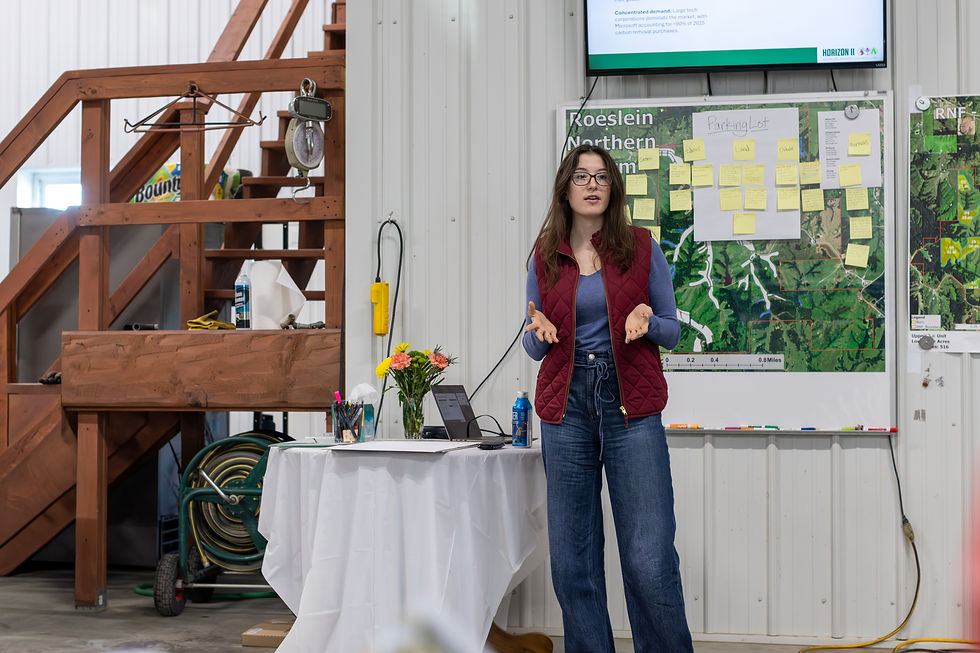
Nothing about Roeslein resembles Bain. When I spoke with her, she had just returned from a three-day workshop at the founder’s farm—four-wheeling across Missouri, staying in one of his many houses in the middle of nowhere, a schedule that felt more like summer camp than a strategy offsite. “It's not that money doesn't matter; it's that it's not not the first question. At Bain, it was always the first question.”
That culture shock has been its own education, but the harder adjustment has been the one back on campus. The week of her big workshop, she was also managing climate week prep for the Kellogg Energy and Sustainability Club, an extra class makeup day, and the start of the new quarter. Caitlin has missed lunch-and-learns, skipped readings, and walked into meetings feeling less prepared than she’s used to.
What’s gotten her through is a recalibration and being more generous with herself. “I’ve officially decoupled my sense of self-worth from my GPA,” she laughs. She shows up, she absorbs what she can, and she lets some things go.
Ally Schoenberg (2Y ’26): The CPG Convert

Ally came to Kellogg as a founder looking to scale her business. As a 2020 graduate, she watched her senior year evaporate when COVID hit, and she started baking elaborate custom cakes and dropping them at friends’ houses to bring a little joy back into the world. It grew into something real. “I started posting them on Instagram, and it just became a whole thing.” She quickly learned that fresh food is a tough business and found herself in CPG as the more viable path to the impact she was after.
That led her to Freestyle Snacks, featured this season on CNBC's Shark Tank. “It’s funny because Freestyle sells olives and pickles, and I hate olives. Olives are one of like three foods I absolutely despise.” She offered to help out one quarter before her internship just to get a foothold. The founder asked her to stay on after the summer. Ally agreed on the condition of a full-time offer waiting on the other side.
She now works 15 to 20 hours a week, fully remote, and she is meticulous about how she protects that time. The backpack emoji is one boundary. Her iPad having no work email and no work Slack is another. She gets paid hourly, which lets her manage her time effectively and step fully away during school breaks. “Scheduling is my solution to everything.” The system works until something disrupts the rhythm. When the second week of the quarter added extra makeup class days, her carefully built routine cracked. “My Wednesdays are days to work. Not having that day messed with the feng shui of my week.”
Despite this, she appreciates that the work gives her what class alone can’t: scale, stakes, and the feeling that her MBA learning is impacting somewhere real. The copy she wrote for the back of Freestyle’s pickle pouches is now sitting on shelves in 300 stores nationwide. “It’s really cool to see something you worked on come to life.”
All four of the MBA-workerbees landed, independently, on the same piece of advice for anyone considering following in their very busy footsteps: only do it if you genuinely care about the work. Not for the income. Not for the resume line. As Ally’s father has reminded her more than once: you have the rest of your life to work. For now, you’re a student. It’s good advice. and Ally has mostly followed it. But she’ll admit to something that her classmates who are dreading graduation probably can’t say: she’s a little excited to get back to doing just one thing. Working two jobs at once, it turns out, makes just one seem pretty manageable.
Read More by Shashank Narayan: Why Your Next Favorite Class Might Not Be at Kellogg At TechCrunch Disrupt, Three Technologies Hit Their Breaking Point at Once


