Everyone Is Publishing. But Why?

By: Vaishnavi (Vaishu) Myadam
A few weeks ago, I came across a TikTok of a woman documenting her flight. She intended to pass the time by watching a few videos after takeoff. Seven hours later, the plane landed. She hadn't slept, read, or watched a movie. She had simply... scrolled.
My first reaction wasn't horror. It was recognition.
I love TikTok. I learn recipes I'll actually cook. I get career advice, news updates, travel recommendations, historical rabbit holes, oddly specific life hacks, and enough niche humor to keep my algorithm frighteningly accurate. If someone starts a conversation with "I saw this TikTok...", I'm listening.
So, this isn't another essay telling everyone to delete social media and touch grass. Frankly, I don't particularly enjoy touching grass.
What interests me more is another question: why has everyone become a publisher?
Not just influencers. MBA students write newsletters (How many Substacks are too many Substacks?). Engineers host podcasts. Consultants post LinkedIn carousels. Designers maintain portfolio websites. Founders publish essays. Researchers build audiences on X. Product managers create YouTube channels. Students polish LinkedIn profiles even before graduating high school.
And everyone, it seems, is building a personal brand.
Publishing used to be reserved for experts. Not long ago, creating public knowledge had gatekeepers. If you wanted to share an idea, you wrote a book, pitched a publisher, or became a columnist. If you wanted to teach, you would become a professor. If you wanted to be heard professionally, your title often mattered more than your platform.
Today, the barriers have almost disappeared.
Anyone can publish a Substack before breakfast, record a podcast over lunch, upload a LinkedIn post after dinner, and wake up to thousands of strangers reading their thoughts.
Publishing is no longer an event. It's a habit.
The interesting part isn't that technology made this possible. It's that so many people choose to do it. Every platform solves a different human need. We often lump social media together, but LinkedIn and TikTok dovery different jobs.
Instagram says, "Here's my life."
TikTok says, "Here's something fascinating."
LinkedIn says, "Here's how I think."
A podcast says, "Spend an hour with me."
A newsletter says, "Invite me into your inbox."
A personal website says, "If you're looking for me, here's who I am."
Each format trades attention, depth, and intimacy differently.
Long-form writing allows uncertainty. You can wrestle with an idea, acknowledge nuance, and admit when you don't have the answer. Podcasts create familiarity through conversation rather than polish.
Short-form content, however, has evolved beyond simple entertainment. The best LinkedIn posts aren't necessarily groundbreaking research. They're compressed thinking. A lesson from a project. An observation after a meeting. A framework someone wishes they'd learned earlier.
In a world where attention is scarce, brevity becomes a feature rather than a limitation.
But why do we post?
This is where things get interesting.
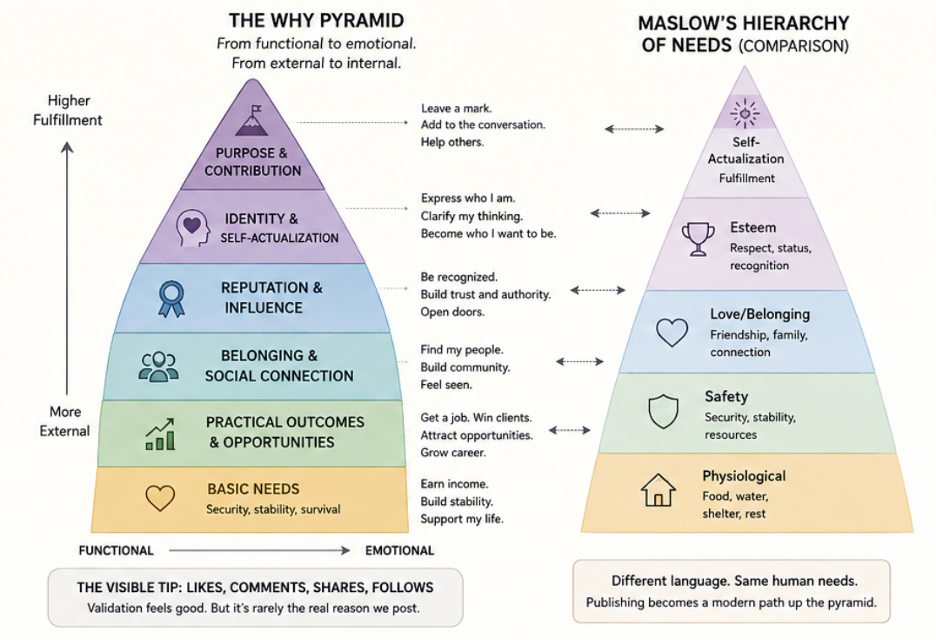
It's easy to assume people post because they want likes. Sometimes that's true. But likes are often just the visible tip of a much larger pyramid.
At the bottom are practical outcomes: finding a job, attracting clients, recruiting teammates, getting speaker invitations, building credibility. Content has become a career asset.
Above that is reputation. People begin recognizing your name before they meet you. In a world where first impressions increasingly happen online, familiarity creates opportunities.
Above reputation sits identity. Posting isn't only communicating with other people; it's communicating with yourself. Every article, podcast, LinkedIn post, or newsletter becomes a small declaration: These are the ideas I find interesting. This is the kind of person I'm trying to become.
That's what makes personal branding so compelling. It isn't simply marketing. It's identity construction.
In some ways, it resembles a modern version of Maslow's hierarchy of needs. Once our basic career needs are met (finding work, earning a living, building security), we naturally move toward belonging and esteem, and eventually something closer to self-actualization. We want to contribute ideas. We want to leave behind something that outlives a meeting, a semester, or a job title.
Maybe that's why so many people start writing newsletters even when they have only a few dozen subscribers. The audience isn't always the point. The act of publishing is.
And somewhere near the top sits something even more universal: Purpose.
Not purpose in the grand, "change the world" sense, but the quiet desire to feel that our experiences, ideas, and expertise have value beyond ourselves. Publishing creates the feeling that our work doesn't simply disappear after the meeting ends, but rather becomes part of a larger conversation.
Status is part of this too, but perhaps not in the shallow sense we often imagine. Humans have always cared about social status because it signals belonging, trust, and influence within a community. Followers, subscribers, and LinkedIn impressions have become imperfect digital proxies for those same instincts.
For most of history, your reputation was local. Today, it can be global.
That's an intoxicating possibility.
Why does an online presence signal expertise?
This puzzles me.
We all know someone brilliant who never posts online.
We also know people who post constantly without saying very much.
Yet when evaluating strangers, we often equate visibility with expertise.
Part of this is practical.
Hiring managers, investors, and collaborators don't have time to interview everyone. Public writing becomes evidence, not necessarily that you're right, but that you've spent time thinking.
An article demonstrates reasoning.
A podcast demonstrates communication.
A consistent body of work demonstrates persistence.
In other words, content becomes a proxy.
An imperfect one, certainly. But a proxy, nonetheless.
The irony is that genuine expertise and online visibility are only loosely correlated. The internet simply makes one much easier to observe than the other.
Is all this content making us smarter?
This question feels impossible to answer honestly.
On the one hand, I've learned more practical skills from the internet than from many formal classes. I've discovered books through creators. I've followed economists who explain inflation more clearly than textbooks. I've learned cooking techniques, negotiation tactics, Excel shortcuts, travel tips, and even obscure historical events because someone condensed years of knowledge into sixty engaging seconds.
That isn't brain rot. That's democratized education.

On the other hand, the same algorithms that surface incredible knowledge also optimize for endless consumption. You can consume hundreds of excellent ideas without integrating a single one.
Learning feels productive. Retention requires effort. Scrolling can give us the sensation of intellectual progress (especially with the “Thought Leader” accounts) while quietly reducing the amount of time we spend wrestling with any idea long enough for it to stick.
Knowledge isn't accumulated through exposure alone. It's accumulated through reflection.
In a sense, posting can be an act of learning rather than merely broadcasting. But there's another side. Once audiences exist, they develop expectations.
Creators begin optimizing for engagement instead of curiosity. Personal identity becomes intertwined with metrics. The line between authentic expression and strategic positioning starts to blur.
It's no coincidence that burnout among creators is increasingly common. When your personality becomes part of your professional asset, it's difficult to know where work ends and you begin.
Maybe that's why the personal and professional keep colliding.
LinkedIn used to resemble a digital résumé. Now, people post marathon training updates, reflections on grief, photos of their children, and lessons from therapy alongside discussions of AI strategy and financial modeling.
At first glance, this feels strange. But maybe it reflects a broader reality. People don't trust polished institutions the way they once did. They trust people.
Professional credibility increasingly comes from being competent and human.
The challenge is deciding how much of yourself belongs online.
There isn't a universal answer.
The woman who accidentally watched TikTok for seven hours wasn't necessarily wasting her time any more than someone reading magazines on a flight thirty years ago. The difference is that today's media doesn't know when to stop.
Likewise, the MBA student posting on LinkedIn isn't necessarily chasing clout. They may be documenting what they're learning, creating future opportunities, or simply trying to make sense of their experiences in public.
We're all consuming more ideas than ever before.
We're also producing more ideas than ever before.
The real question isn't whether that's good or bad.
It's whether we're building a digital presence that reflects who we are or slowly becoming whatever the algorithm rewards.
Read More from Vaishu Myadam:


